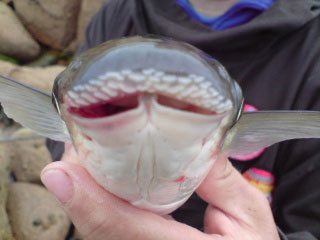
Chelon labrosus

Distinguishing features
The torpedo shaped body of the thick-lipped mullet is covered with large scales. The anterior of the two dorsal fins has four spines. The upper lip is broad and more than half of the diameter of the eye in depth. The pectoral fin covers most of the eye when folded forward. Its back varies from dark green to bluey grey merging into grey stripes running from the gills to the tail over a silver background. Other than the anal fin, grey, those on the ventral side are white.
Size
The thick-lipped mullet can grow to about 80 cm and attain a weight of around 6 kg.
h4>British Record Fish List
UK Shore Record: 14lb 2oz 12dms / 6.427kgs
UK Boat Record: 10lb 1oz 0dms / 4.564kgs}
European Line Class Record for this species
Habitat
It is a summer migrating species which can be found in the coastal waters around the UK, France, and Spain and down the Mediterranean and North West Africa. It is commonly found in harbours, estuaries and other inshore water.
Food
Feeds on vegetative matter, plankton, worms, copepods, small crustaceans and molluscs.
Bait
A wide range of baits can be used for this mullet depending upon the locality. Bread in particular is widely used but small fish baits and ragworm can also be effective. Maggots, sweetcorn and other freshwater type baits have landed mullet. They respond well to groundbaiting.
Lures
The mullet can be taken by fly fishing particularly when feeding on the maggots of seaweed flies.